How Does an RFID Asset Tracking System Work?
Learn more about the RFID Asset Tracking system. Active and passive RFID and what are they used for? RFID for inventory tracking is the best choice for you.
An RFID Asset Tracking elevates your equipment management, monitoring, and other operations to the next level. If you're looking for a better way to manage your inventory, RFID Asset Tracking technology can help. The technology collects data about your assets that can be used to optimize asset utilization and better manage inventory.
However, before you can use the collected data, you need a plan for its use. Otherwise, you're left with just a pile of numbers. But don't worry, with the right deployment of these systems, you will notice a significant improvement in your company's efficiency.
What is RFID Asset Tracking?
RFID Asset Tracking refers to the process by which you document all of your company's physical assets. The RFID Asset Tracking technology automates the manual processes of asset management. It brings significant labor savings. Reduces time, energy and costs significantly.
Asset Tracking RFID technology is a system your company can implement to gain better control over your critical tools and equipment.
With Asset Tracking, your company can:
- Simultaneously view the assets you own and their location
- Ability to monitor who is responsible for critical assets
- Track asset movements
- Search for lost or misplaced assets
- Maximize inventory accuracy
All these functions ultimately streamline your company's ongoing operations and prevent asset loss and theft.
The Importance of RFID Asset Tracking
While several options are available to streamline the process of RFID Asset Tracking, there is a tracking technology that offers full efficiency in the most cost-effective way. RFID Asset Tracking technology stands for “Radio Frequency Identification,” a technology that operates via radio waves.
In its simplest form, RFID Asset Tracking is a way to automate the management and localization process of physical assets. It works by uploading data to an RFID tag and attaching it to a related entity. This data can include name, condition, quantity, and location.
Since the onset of the pandemic, we have become increasingly accustomed to the idea of accessing or doing things without having to touch anything. And one of the technologies that helps us get things done quickly without having to touch anything is Asset Tracking RFID technology.
How Does RFID Asset Tracking Work?
Regardless of the industry used, the basic principles of how an RFID tracking system works are the same. RFID tags are physically attached to your valuable assets. RFID readers are tailored to your business environment and strategically placed to “read” the signals sent by RFID tags. They are transmitted to our RFID Asset Tracking software and the data is processed. Through an intuitive user interface, you can track and locate specific assets from a laptop on-site, remotely via your web browser, or even with your mobile device on the go.
The components of the system are as follows:
- RFID tags (Passive, Active, or Semi-Passive)
- An antenna
- RFID reader
- A computer database equipped with RFID Asset Tracking software
RFID Asset Tracking Process
- Data is stored in an RFID tag with a unique electronic product code and attached to an asset
- An antenna identifies the signal of a nearby RFID tag
- An RFID reader wirelessly connects to the antenna and receives data stored on the RFID tag.
- The RFID reader then transmits the data to an RFID Asset Tracking database, where it is stored, evaluated, and processed.
RFID Readers
It uses internal antennas to emit radio waves to retrieve signals from RFID tags (or, wirelessly connects to the antenna to receive information in more complex systems). Readers are typically mobile, meaning users can take them anywhere, but they can also be mounted (e.g., on a high mast, allowing them to see a large portion of a warehouse). RFID readers evaluate information in real-time and can transmit the data to a software system where it is stored and referenced as needed.
Definition of RFID Tags
RFID tags are a type of RFID Asset Tracking system that uses smart barcodes to identify items. RFID tags use high-frequency technology. These radio waves transmit data from the tag to a reader and then the information to an RFID computer program. An RFID tag can also be referred to as an RFID chip.
RFID tags are attached to each asset and continuously transmit data to an antenna (integrated or separate from the reader). RFID tags can store a wealth of information, from a single serial number to pages of associated data from manufacturing date, condition, and temperature to serial number, location, movements, and storage requirements. Anything important to the organization and can be digitized can be loaded onto a label for processing.
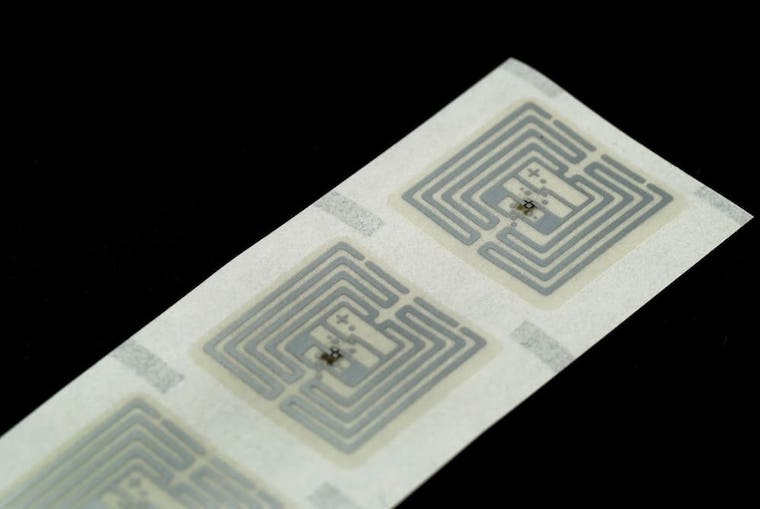
There are three main types of RFID tags
- Active RFID: An active RFID Asset Tracking has its own power source, usually a battery. They are battery-powered tags that continuously transmit signals. It is often used in processes for real-time asset monitoring, such as vehicle tracking and charging. Depending on the frequency of the tag, active RFID Asset Tracking has a signal range of up to approximately 150 meters. Additionally, it is generally more expensive than passive RFID Asset Tracking.
- Passive RFID: Unlike the conventional way of item tracking, with passive RFID Asset Tracking, you can add and remove RFID readers as needed. You can track items more efficiently by adding more RFID readers. It has no internal power supply and is powered by an RFID reader or antenna. It is often used for inventory tracking, supply chain management, and access control. It has a lower signal range than active RFID Asset Tracking. Additionally, it is smaller, lighter, and has a longer lifespan than active RFID Asset Tracking. Moreover, it is also a cheaper option than active RFID Asset Tracking.
- Semi-passive RFID tags: Is a mix of both, having both internal batteries and an antenna and an RFID chip. It has a lower signal range compared to the active RFID tag. The inclusion of a battery enables additional functions such as real-time monitoring and sensors. It is used in close proximity to the RFID reader. It is often used for environmental and condition monitoring such as temperature-controlled switching.
Why Companies Choose RFID for Inventory Tracking
Nowadays, companies focus on increasing their operational efficiency to stay ahead of the competition. Asset Tracking systems with RFID are used in many major industries, including logistics, automotive, manufacturing, retail, and construction. The use of Asset Tracking RFID technology allows companies to automatically track the movement of goods.
The data collection process is also automated, allowing companies to receive accurate real-time updates directly to an RFID Asset Tracking system. From here, asset managers can monitor inventory, oversee the supply chain, and even detect costly delays in operations. This eliminates the need for manual monitoring methods such as spreadsheets, effectively reducing employee work time and human intervention.
Work Smarter with the RFID Asset Tracking System
RFID is not only popular in asset management but also takes control of employee performance. The new passive RFID-enabled system is designed to monitor employee attendance, productivity, workflows, and more. For example, you can measure the time it takes a mechanic to repair a service tool.
This is achieved through the use of RFID-based employee badges. The RFID performance tracking system can seamlessly integrate into the RFID asset tracking system and enhance your company's overall efficiency. Investing in a versatile system of RFID Asset Tracking technology allows you to work smarter and master your assets, workflows, and employees.