How Manufacturing Companies Optimize Material Flow with Real-Time Localization
How an RTLS optimizes production processes: transparency, reduced search times, automated workflows, and a quick ROI
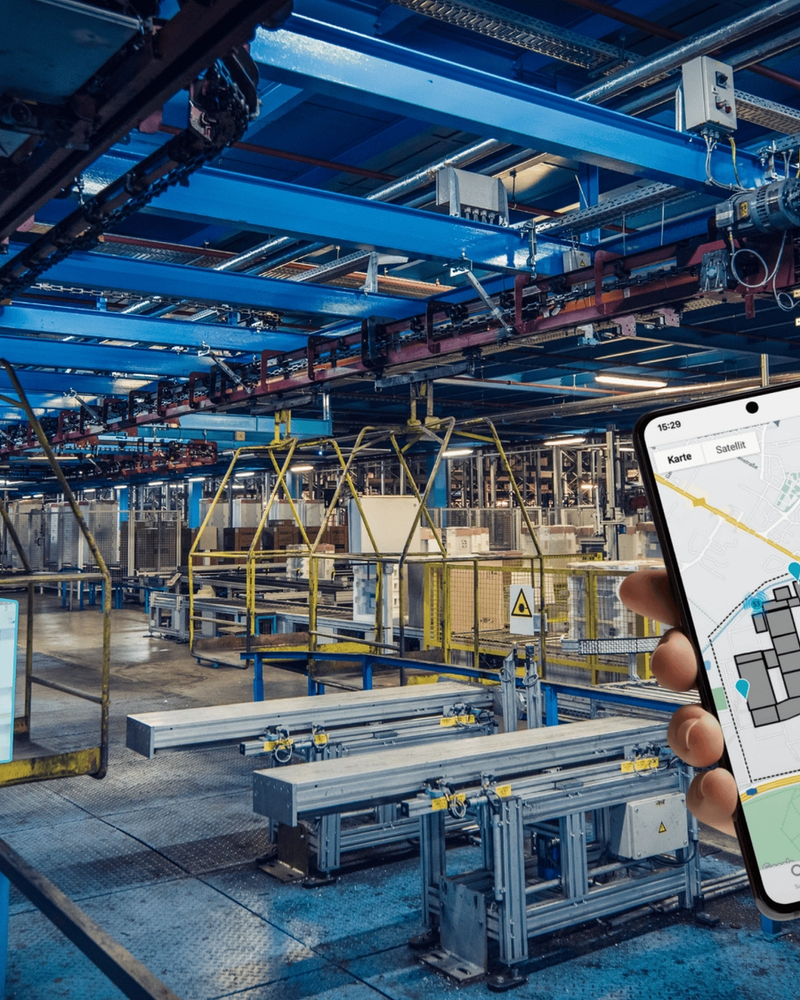
How Manufacturing Companies Benefit from an RTLS
Manufacturing companies face the daily challenge of continuously optimizing their processes, ensuring smooth material flows, and staying competitive. Real-Time Location Systems (RTLS) provide valuable support by enabling the tracking of materials, load carriers, tools, and products in real time.
An RTLS creates transparency along the entire value chain and allows for more precise planning and control of production processes, inventory control, and the ability to use production facilities more efficiently. This leads to significant cost savings by reducing search times, shortening lead times, and optimizing inventory levels.
Especially in times of skilled labor shortages, it allows for the digitalization and automation of processes to enable the productive use of employees. They are no longer occupied with search efforts and time-consuming manual tasks.
An additional advantage is the ability to identify valuable optimization opportunities through data-driven process analyses. Companies can continuously improve their production processes based on the collected real-time data and proactively avoid bottlenecks, production disruptions, and delivery delays. For manufacturing companies, an RTLS can therefore be a decisive competitive advantage.
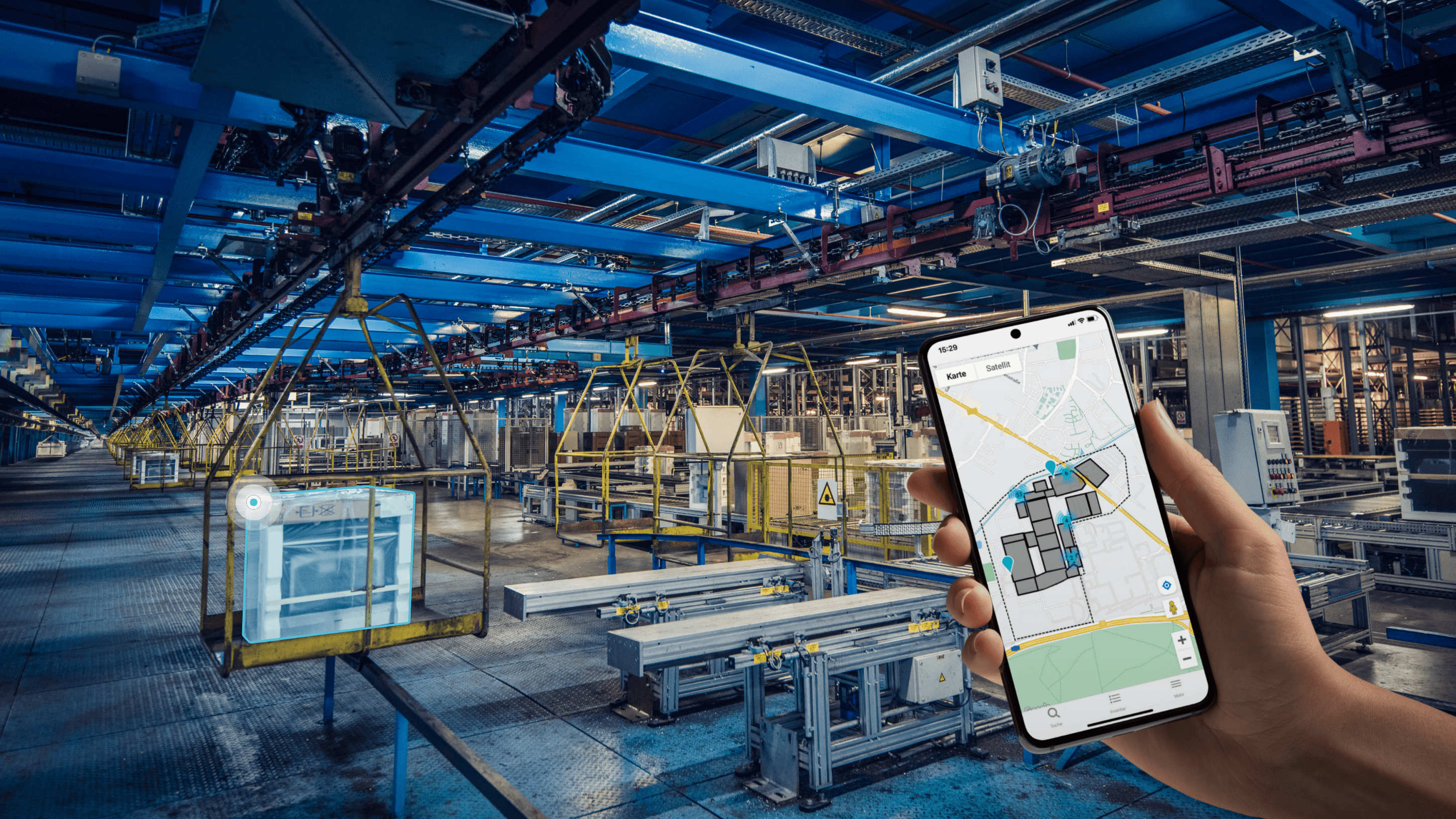
What is an RTLS and how does it work?
A Real-Time Location System is a highly precise and versatile system for determining and tracking the position of objects or people in real time. It is based on the localization of devices that emit signals using Bluetooth, Ultra-Wideband, or other technologies. Tags are attached to the assets to be tracked, which calculate their position via a network of anchors. The position data can be determined through a clever interplay of components:
- A tracking tag sends signals at regular intervals. These are received by all anchors within the communication range and sent to the central system with a timestamp. From the differences in arrival times at the individual anchors, it calculates the coordinates of the tag.
- Alternatively, RTLS sensors can detect the received signal strength to determine the location of the transmitting devices.
- At the same time, they can also measure the angles of signals emitted by the tags. This information enables location determination with high accuracy.
- However, the tags can not only send signals to the anchors but also communicate directly with each other. When a device is in close proximity to another, they begin to detect each other to determine their distance.
The collected signal data is processed in central software, and the exact position of the tags is calculated. These are displayed in a user-friendly interface, often in the form of an interactive map or dashboard. Here, users can track the location and movement history of individual objects in real time.
Modern RTLS solutions, such as the Realtime Asset Visibility Hub by SmartMakers, enable not only pure location tracking but also analyses and reports as well as process automation. For example, the system can automatically book material movements into ERP systems or issue alerts when an object reaches a certain zone or remains stationary for too long (geofencing).
What to Consider When Choosing an RTLS
Since production processes and warehouse logistics vary greatly depending on the industry and company, the RTLS should be tailored to your specific requirements. A few key points to consider when selecting are:
- Location accuracy and update rate: Depending on the production process, material flow, and asset to be tracked, different requirements arise for location accuracy and update rate. Some processes require centimeter-accurate location and millisecond-accurate updates, while for others, it is sufficient to determine the location of a component to within 2-5 meters at a frequency of 10 minutes. This requirement has a significant impact on the choice of the appropriate RTLS.
- Compatibility and integration: An RTLS should seamlessly integrate into your existing ERP (Enterprise Resource Planning) or MES (Manufacturing Execution Systems) to enable a holistic view of all processes. Integration into these systems allows you to incorporate location data directly into production control, make real-time data-driven decisions, and leverage high automation potential.
- Scalability: The RTLS should be able to grow with your company. A scalable system can be expanded to different assets or application scenarios without requiring major technical changes – an essential feature for companies focused on growth and flexibility.
- Cost and economic efficiency: RTLS solutions vary greatly in price and should be proportionate to the expected benefit. This does not always mean that the cheapest or most expensive solution is the best choice – rather, you should carefully weigh the investment and the added value of the system in relation.
- Reliability and robustness: Production environments can be demanding, especially due to temperatures, dust, or humidity. Additionally, a lot of metal is often installed or stored, which can block or reflect signals. Therefore, the RTLS should work reliably even under adverse conditions to continuously provide precise location data. At the same time, the battery life of the devices used should be as long as possible to keep maintenance efforts low.
The Advantages of the SmartMakers RTLS
The IoT-based RTLS (IoT = Internet of Things) from SmartMakers uses Bluetooth technology and its own mesh architecture, specifically optimized for IoT applications. It offers you specific advantages in production compared to other technical approaches to location determination. Here are the key aspects in detail:
Real-Time Location and Data Availability
IoT-based RTLS systems process and transmit location data across all areas in all production halls in real time to central platforms, providing you with immediate insights into material flow, production utilization, and resource location. Other systems, such as purely passive tracking solutions, require manual interventions for scanning (barcode or QR code) or stationary readers (RFID) and do not offer continuous location monitoring.
Very Low Implementation and Infrastructure Costs
IoT RTLS solutions require no elaborate cabling and minimal physical network infrastructures. The hardware is battery-powered and transmits data over its own wireless network, so no LAN connections are needed. Installation is therefore very quick and cost-effective. The function of RFID systems, on the other hand, relies on the installation of readers at all points where information is to be captured. A UWB system requires a dense network of Gateways for precise location, which requires power and network connections. Both are therefore significantly more expensive and less flexible in setup and operation. Installation costs and effort for the SmartMakers RTLS system are 7 to 10 times cheaper.


Flexibility and Scalability
IoT-based RTLS systems can be easily adapted and expanded to changing production environments. They grow with the requirements of your company. Systems that require a larger infrastructure are less flexible because they need to be physically altered and are not dynamically expandable. The SmartMakers RTLS features decentralized network management, where each device independently makes decisions about data forwarding. This eliminates the need for a central network controller, further increasing scalability and reliability.

Sustainability and Energy Efficiency
Modern IoT RTLS systems operate with energy-efficient wireless technologies and offer long battery life. This reduces operating costs and environmental impact. Other approaches, such as UWB, are often more energy-intensive and have a shorter lifespan, requiring regular maintenance.
An RTLS that Offers Manufacturing Companies a High ROI and Quickly Pays for Itself
The RTLS system from SmartMakers was specifically developed for manufacturing companies that need a cost-effective, quick, and easy-to-implement solution. Through seamless integration into existing infrastructures and ERP systems, you can immediately optimize your production processes without complicated changes.
The SmartMakers RTLS relies on state-of-the-art IoT-based tracking technologies that not only provide precise location data but also impress with high automation potential. You particularly benefit from increased transparency and detailed real-time analyses that help reduce costs, minimize lead times, and continuously streamline processes.
The RTLS solution is offered as a managed service, which includes all necessary components for smooth operation. SmartMakers customers do not need to build their own expertise internally. Especially in times of high skilled labor shortages, manufacturing companies can quickly leverage the great potential of an RTLS and benefit from SmartMakers' wealth of experience.
Would you also like to take advantage of real-time localization in your production? We offer free and non-binding advice!