What is an IoT Platform?
Learn what an IoT platform is, how it works, and why it is crucial for applications in logistics and Industry 4.0.
An IoT platform is a digital infrastructure that connects devices, sensors, machines, and applications in the Internet of Things. It serves as an interface between the physical and digital worlds by collecting, processing, analyzing, and making data available to users or other systems.
IoT platforms are thus the heart of any IoT solution: They enable billions of IoT devices to communicate securely and efficiently, and the information obtained can be used for automation, monitoring, or optimization.
How does an IoT platform work?
The process can be divided into four core steps:
- Device connectivity: IoT devices send their data via wireless technologies such as Wi-Fi, cellular (LTE, NB-IoT, 5G), LoRaWAN, or Bluetooth to the platform.
- Data management: The platform manages, stores, and structures this data.
- Analysis & processing: Using algorithms, business intelligence, and artificial intelligence, data is evaluated and transformed into actionable information.
- Integration & utilization: Results are available in dashboards, apps, or via interfaces (APIs) for other systems such as ERP, CRM, or logistics software.
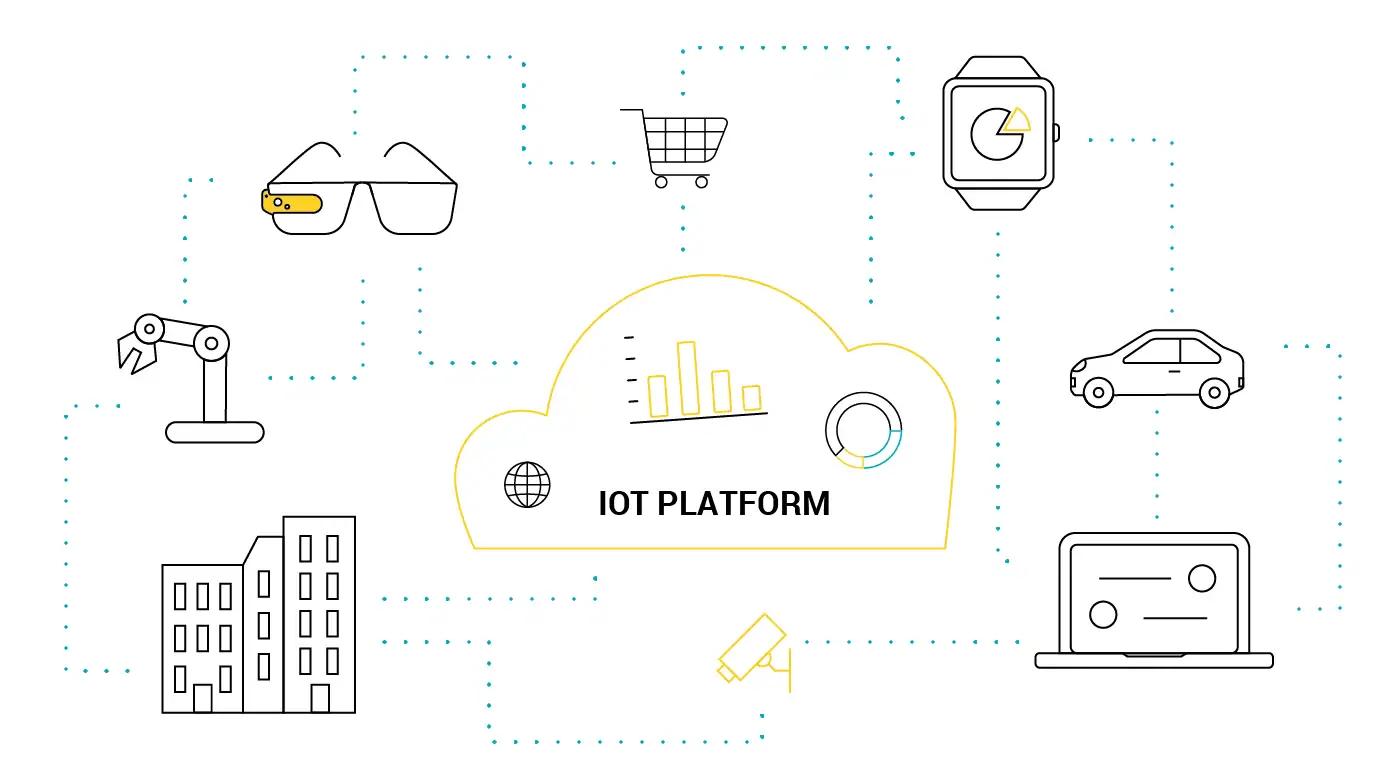
Key features of an IoT platform
- Device management: Registration, authentication, and management of thousands of devices.
- Data security: Encryption, access controls, and protection of sensitive data.
- Scalability: Usable from pilot projects to global rollouts.
- Real-time monitoring: Monitoring of devices, assets, and processes in real-time.
- Integration: Interfaces to existing enterprise systems (ERP, CRM, MES).
Benefits
- Central control: All IoT devices can be managed via one platform.
- Cost efficiency: Unified infrastructure reduces integration effort.
- Flexibility: Adaptable to various industries and applications.
- Transparency: Clear visualization of data streams and processes.
- Automation: Data-driven workflows optimize processes.
Use cases
- Logistics: Real-time tracking of supply chains, cold chain monitoring, and asset management.
- Industry 4.0: Predictive maintenance, machine monitoring, production optimization.
- Smart Cities: Control of street lighting, traffic flow, or waste management.
- Energy & Environment: Monitoring of electricity, water, and gas consumption as well as integration of renewable energies.
- Healthcare: Networking of medical devices, telemedicine, and patient safety.
Future perspective
With the advent of 5G, Edge Computing, and AI, IoT platforms are becoming even more powerful. In the future, they will not only collect and analyze data but also make autonomous decisions in real-time and integrate even more closely into industrial and urban infrastructures.
Summary
An IoT platform is the central hub for the Internet of Things. It connects devices, collects data, analyzes it, and makes it available for applications. Without IoT platforms, smart cities, connected industrial processes, or digital logistics systems would hardly be possible.
Talk to us – we will show you how easy Asset Tracking can be today.